Software architecture platform · Prelaunch

A shared architecture model for teams building with AI.

Continuum keeps your system’s boundaries, business rules and decisions in one model that people and AI coding agents can read and check before they change code. Keep your architecture decisions with the project.

What goes wrong today: the next engineer or agent session sees the code, not the reasons. In HashRelay, the architecture said missed notifications were kept until acknowledged. The code expired them after 24 hours, and the dashboard still counted them as delivered.

For architects, developers and engineering leaders whose teams write code with AI agents.

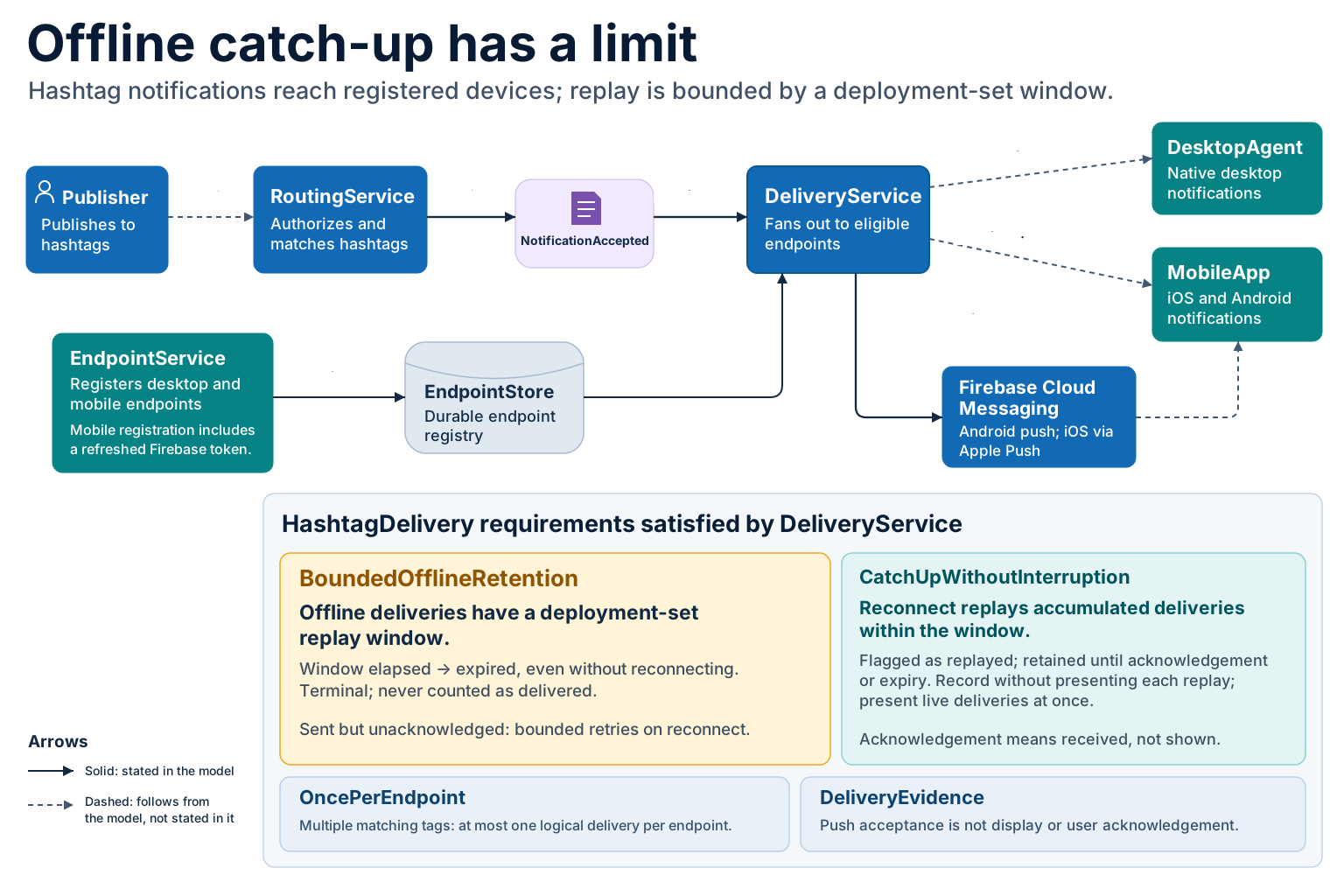
HashRelay · from its compiled modelReal output
Drawn by Continuum Diagram from HashRelay’s compiled model. 19 of 23 elements are declared in the model, and 4 dashed arrows are inferred. Open full size · How it was checked
ADR-001In forceAccepted 5 Nov 2026

A delivery queued for an offline device is kept until it is acknowledged or its replay window (24 hours by default) elapses. An expired delivery is never counted as delivered.

The decision this diagram explains. It was proposed by an AI agent and accepted by the project owner, with the alternatives and risks on record.

The platform

One model at the centre. Everything else is tied to it.

Continuum is a software architecture platform. Its core is an explicit model of how your system works, written in two small languages. Decisions, checks, diagrams and revision history all point back to the same model, so a person or an agent who opens it next week starts from the same place you left.

The architecture model

Plain, versioned source that lives with your project.

ADL · the system: services, messages, data stores, requirements, and which service satisfies which requirement.
BDL · the business: entities, actions, obligations, and the questions nobody has answered yet.

Decisions

Why it is this way

Each decision records its rationale, the alternatives considered and the risks, plus the model elements it expects to exist.

HashRelay: ADR-001 names the requirement and the service that must satisfy it.

Validation

Is the model sound?

The compiler resolves every reference and runs its rule checks. It also flags intent nothing realizes yet.

HashRelay: 78 checks passed, 0 errors, 18 review warnings.

Diagrams

What it looks like

Diagrams are drawn from the compiled model and checked against it, with inferred parts marked.

HashRelay: the replay diagram above, 0 claims drawn stronger than the model supports.

Revision history

What changed, and from where

Changes are written as change files against a pinned model state, so the next session knows exactly what it builds on.

HashRelay: a proposal six days later started from the state ADR-001 produced.
What validation checks Model

  • The model compiles: every name resolves and every relationship is allowed.
  • A decision’s expectations hold in the model. For ADR-001, the check reported 2 expectations missing before the change and both satisfied after it.
  • Review warnings for gaps, such as a requirement with no test declared to verify it.

What it does not check Code

  • Whether your code does what the model says. Model checks never read your source.
  • Test results and other implementation evidence are recorded as reported, not verified by Continuum.
  • Whether the model captured every requirement that matters. That still takes people.

Why it matters

The cost of lost intent shows up in the next session.

AI agents write code quickly, then forget. A new engineer reads the code and has to guess. Either one can “fix” behaviour that was a deliberate decision, or keep a promise the system never actually made. A shared model gives everyone the same answer to what did we decide, and why?

Architects

Decisions stay attached to the elements they govern, with alternatives and risks, instead of fading in a document nobody opens.

Developers and their agents

Read the accepted requirement before changing code, and start the next session from a pinned model state rather than a summary.

Engineering leaders

See what is decided, what has been checked and what is still unknown, each labelled for what it actually establishes.

Proof · HashRelay

How long should a missed alert wait for an offline laptop?

HashRelay sends notifications from scripts, CI jobs and AI agents to devices subscribed to a hashtag. Avlon built it with Continuum. The case study follows one real decision from the mismatch an agent found to the tests on either side of the 24-hour boundary.

Change review

2 missing → aligned

The decision check found its two expectations missing from the model. After the change, both held.

Either side of 24 h

23 h queued · 25 h expired

Regression tests pin the boundary. The test that expired deliveries are never counted as delivered failed before the fix.

Next session

Carried forward

Six days later, an agent drafting macOS and Linux support started from the same model state and kept the replay rule as stated.

Status

What works today, and what is still in development

Continuum has not launched yet. Here is where each part stands, based on Avlon’s own project records.

CapabilityStatusEvidence
ADL and BDL models, compiled and validatedUsed on Avlon projects

HashRelay’s model compiles with 78 checks passed and 0 errors.

Signed decision records with model checksUsed on Avlon projects

HashRelay’s record holds 19 signed events and 3 decisions.

Diagrams drawn and checked from a modelUsed on Avlon projects

The replay diagram on this page was generated and verified for this site.

One project shared across ChatGPT and Claude CodeDevelopment deployment

Round trip demonstrated on 15 Nov 2026 with a small test project. Not released.

Proof that code conforms to the modelNot claimed

Continuum records implementation evidence as reported. It does not certify code.

Follow the launch

Walk through one decision from question to code, then ask to hear when you can try Continuum on your own project.